
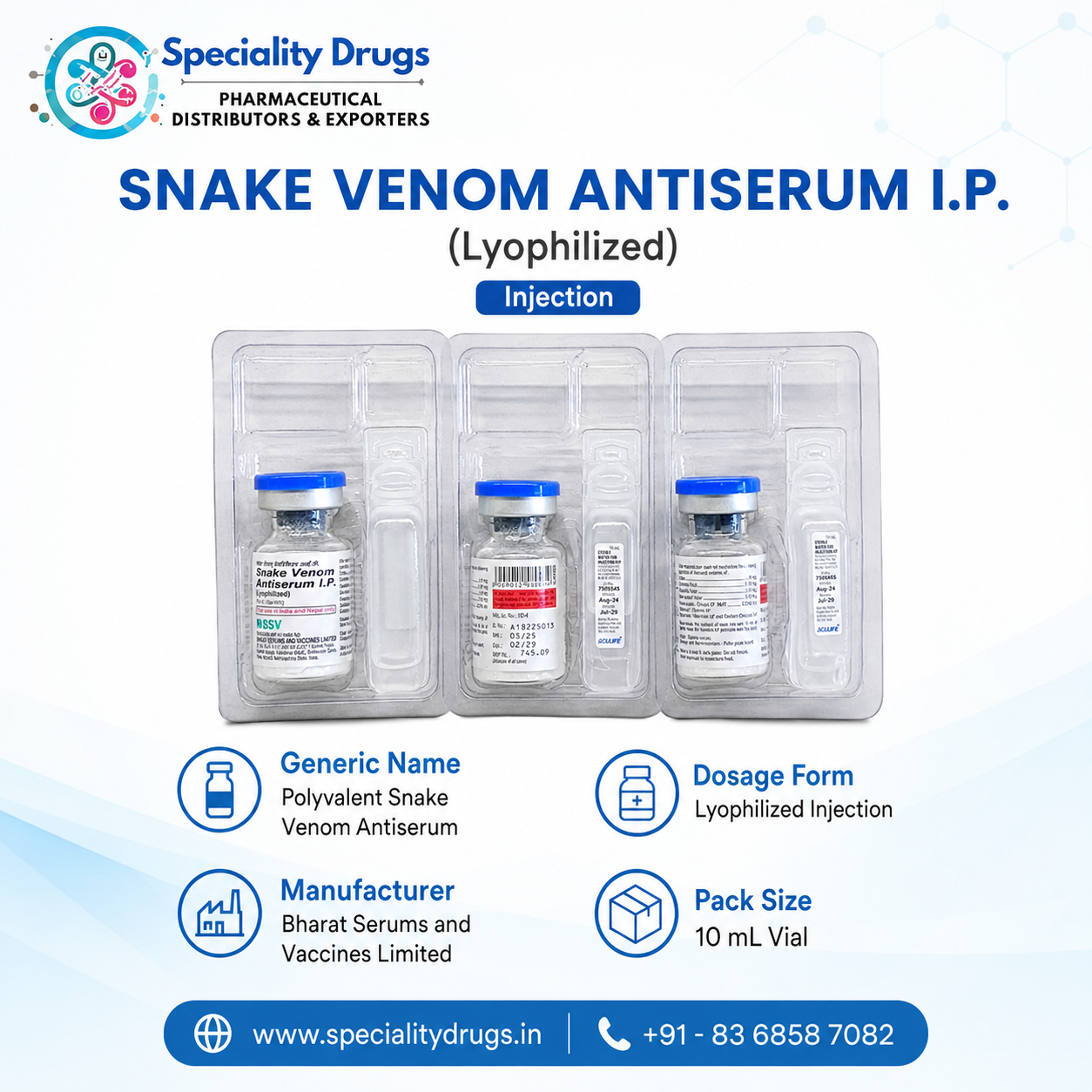
What is Snake Venom Antiserum I.P.?
Snake Venom Antiserum I.P. (Lyophilized) is a polyvalent antivenom injection used in the emergency treatment of clinically significant snake envenomation. It contains antibodies capable of binding and neutralizing venom toxins. The product is manufactured by Bharat Serums and Vaccines Limited, and Bharat’s polyvalent antivenom is listed among Indian snake antivenoms in WHO materials.
The product is intended to provide protection against venom from the medically important “Big Four” snakes commonly associated with severe envenomation in India:
- Indian cobra (Naja naja)
- Common krait (Bungarus caeruleus)
- Russell’s viper (Daboia russelii)
- Saw-scaled viper (Echis carinatus)
Available product information describes the polyvalent formulation as containing activity corresponding to 0.60 mg cobra venom, 0.45 mg common krait venom, 0.60 mg Russell’s viper venom and 0.45 mg saw-scaled viper venom per mL of reconstituted preparation.
Snake venom can affect the nervous system, blood clotting, muscles, tissues and other organs. Antivenom works by supplying antibodies that bind venom components and prevent them from continuing to exert their toxic effects.
Snake Venom Antiserum is an emergency hospital medicine, not a routine medicine for home use. It must be administered by appropriately trained healthcare professionals after assessment of the patient’s clinical condition.
Uses of Snake Venom Antiserum I.P.
Snake Venom Antiserum I.P. uses are primarily associated with the treatment of venomous snakebite with evidence of envenomation. It is not intended to be given automatically for every snakebite; the decision to administer antivenom depends on clinical findings and medical assessment.
Commonly accepted use includes:
- Treatment of clinically significant snake envenomation
- Neutralization of venom from susceptible cobra bites
- Management of envenomation caused by common krait
- Management of Russell’s viper envenomation
- Management of saw-scaled viper envenomation
- Prevention or reduction of further systemic complications caused by circulating venom
The exact effectiveness of antivenom can vary according to the snake species, geographic venom variation, amount of venom injected, time since the bite and severity of envenomation.
This medicine should only be taken under the supervision of a qualified healthcare professional.
Benefits of Snake Venom Antiserum I.P.
Snake Venom Antiserum benefits come from its ability to neutralize venom toxins after envenomation.
Potential clinical benefits include:
- Helps neutralize circulating snake venom toxins
- Helps prevent progression of systemic envenomation
- Supports treatment of venom-related blood-clotting abnormalities
- Helps reduce the effects of neurotoxic venom when the antivenom is appropriate
- Helps limit further venom-mediated tissue and organ injury
- Supports recovery when used promptly in clinically indicated cases
- Forms an important part of hospital management of serious snakebite
Antivenom is not a substitute for overall snakebite management. Patients may also require airway and breathing support, treatment of bleeding or shock, wound care, monitoring of kidney function and other supportive measures depending on the type and severity of envenomation.
How Does Snake Venom Antiserum I.P. Work?
Snake Venom Antiserum contains antibodies produced against specific snake venoms. These antibodies are designed to recognize venom components.
After administration, the antibodies bind to venom molecules circulating in the patient’s body. This antigen-antibody reaction helps neutralize toxins, preventing them from continuing to interact with their biological targets.
For example, some snake venoms contain neurotoxins that interfere with nerve and muscle function, while viper venoms can produce serious abnormalities in blood clotting and bleeding. By neutralizing susceptible venom toxins, antivenom helps stop or reduce ongoing toxic effects.
The antivenom does not instantly reverse every injury already caused by venom. This is one reason why early assessment and appropriate hospital treatment are important.
How to Take Snake Venom Antiserum I.P.
Snake Venom Antiserum is not a self-administered medicine. It is supplied as a lyophilized preparation that requires appropriate reconstitution before administration.
General guidance includes:
- It should be administered only by a qualified healthcare professional.
- The lyophilized product must be reconstituted according to the manufacturer’s instructions.
- Administration is generally performed in a hospital or appropriate medical facility.
- The route, amount and number of vials are determined by the treating clinician based on the clinical evidence of envenomation.
- Do not attempt to inject or reconstitute the product yourself.
- Patients should remain under medical observation because serious allergic reactions can occur.
- Do not delay emergency medical treatment while trying to obtain or administer antivenom independently.
There is no appropriate home dosage of Snake Venom Antiserum I.P. The Snake Venom Antiserum dosage must be determined by a healthcare professional according to the clinical presentation and treatment protocol.
Side Effects of Snake Venom Antiserum I.P.
Like all medicines, Snake Venom Antiserum I.P. may cause side effects, although not everyone experiences them.
Common Side Effects
Possible reactions may include:
- Fever or chills
- Skin rash
- Itching
- Nausea or vomiting
- Headache
- Body or muscle discomfort
- Swelling or other infusion-related reactions
Because antivenoms are commonly produced using antibodies derived from immunized animals, hypersensitivity reactions can occur.
Serious Side Effects
Immediate medical attention is required if symptoms suggest a severe allergic or infusion reaction, including:
- Difficulty breathing
- Wheezing or bronchospasm
- Swelling of the face, lips or throat
- Severe dizziness or fainting
- Marked fall in blood pressure
- Widespread hives
- Severe or rapidly worsening allergic symptoms
Delayed serum-sickness-like reactions can also occur after treatment with animal-derived antivenom.
If side effects persist or become severe, contact your healthcare provider promptly.
Warnings and Precautions
Snake Venom Antiserum should be administered in a setting where the patient can be monitored and treated for potential hypersensitivity reactions.
Pregnancy
Pregnancy does not automatically prevent the use of antivenom when significant snake envenomation is present. A serious untreated snakebite can pose substantial risks to both mother and fetus. The treating doctor should assess the situation and administer antivenom when clinically indicated.
Breastfeeding
Inform the treating healthcare professional if the patient is breastfeeding. In an emergency, treatment of clinically significant envenomation takes priority, while the medical team evaluates the individual circumstances.
Liver and Kidney Disease
Tell the doctor about existing liver or kidney problems. Severe snake envenomation itself can affect organ function, so appropriate laboratory monitoring and supportive care may be necessary.
Heart Disease
Patients with significant heart or circulatory disease should be monitored carefully during emergency treatment, particularly when severe envenomation or infusion-related reactions are present.
Allergies
Tell the medical team about previous severe allergic reactions, particularly reactions to horse-derived or other animal-derived biological products.
Elderly Patients
Older adults may require careful monitoring because they can have underlying medical conditions that influence the effects of envenomation and emergency treatment.
Alcohol
Alcohol does not treat snakebite and should not be used as a home remedy. A person with suspected envenomation requires urgent medical evaluation.
Driving and Operating Machinery
A person who has been bitten by a potentially venomous snake should not drive themselves to obtain treatment. Emergency medical care and monitoring are required.
Drug Interactions
Snake Venom Antiserum may be used alongside other emergency treatments for snakebite, but the healthcare team should know about all medicines the patient is taking.
Tell the doctor about:
- Prescription medicines
- Over-the-counter medicines
- Vitamins and minerals
- Herbal products
- Other injections or biological medicines
- Previous medicines that caused serious allergic reactions
The medical team will determine which treatments are appropriate based on the patient’s symptoms, laboratory findings and overall condition.
Storage Instructions
Storage requirements should always follow the specific product label and manufacturer’s instructions.
For the lyophilized Bharat Serums formulation, available product information describes storage below 25°C, while some current pharmacy listings for antivenom presentations specify refrigerated storage. Therefore, healthcare facilities should follow the storage condition printed on the particular pack being supplied rather than assuming that all antivenom presentations have identical storage requirements.
General precautions:
- Keep the vial in its original packaging.
- Protect it from excessive heat and inappropriate environmental exposure.
- Do not use after the expiry date.
- Keep medicines away from children.
- Do not use a vial if its packaging or seal appears damaged.
- Follow the manufacturer’s instructions for reconstitution and handling.
Snake Venom Antiserum I.P. Price and Availability
The Snake Venom Antiserum I.P. price can vary depending on the manufacturer, formulation, pack, distributor, applicable government price controls and market availability. The product is also subject to prescription and hospital-use requirements in many settings.
Because antivenom is an emergency biological medicine, purchasing it online should never delay emergency treatment. Patients should be taken to an appropriate healthcare facility immediately after a suspected venomous snakebite.
Snake Venom Antiserum I.P. Manufacturer
The product shown in the supplied image is labelled as Snake Venom Antiserum I.P. (Lyophilized) and identifies Bharat Serums and Vaccines Limited. WHO materials list Bharat Serums and Vaccines Limited as an Indian manufacturer of Snake Venom Antiserum (Lyophilised).
Disclaimer
This Snake Venom Antiserum I.P. medicine information is provided for educational purposes only and should not be considered medical advice.
Snakebite can be a life-threatening medical emergency. Do not self-medicate, attempt to administer antivenom yourself, or delay emergency care while researching treatment. The appropriate antivenom, route of administration, number of vials and duration of treatment must be determined by a qualified healthcare professional.
Always follow the doctor’s prescription, hospital protocol and manufacturer’s product information. Individual responses to antivenom can vary, and treatment depends on the snake species, severity of envenomation and patient’s clinical condition.
Frequently Asked Questions
1. What is Snake Venom Antiserum I.P. used for?
Snake Venom Antiserum I.P. is a polyvalent antivenom used for clinically significant envenomation from susceptible venomous snakes. The Bharat formulation is associated with the major Indian snake groups including cobra, common krait, Russell’s viper and saw-scaled viper. It is administered in a medical setting following clinical assessment.
2. How does Snake Venom Antiserum work?
It contains antibodies that recognize and bind to venom toxins. By binding these toxins, the antivenom helps neutralize their harmful effects and prevents additional toxin activity. It does not necessarily reverse damage that has already occurred, which is why timely medical evaluation and supportive treatment are important.
3. Is Snake Venom Antiserum I.P. safe?
It is an established treatment for significant snake envenomation, but it is not completely free from risks. Allergic and infusion-related reactions can occur, including potentially severe anaphylaxis. For this reason, it should be administered by trained healthcare professionals in a setting equipped to manage serious reactions.
4. Can Snake Venom Antiserum be used long term?
No. Antivenom is an emergency treatment for snake envenomation rather than a long-term medicine. The amount and duration of treatment depend on the patient’s clinical response and medical assessment. It should never be taken routinely or used as a preventive medicine without a specific medical indication.
5. What happens if I miss a dose?
Snake Venom Antiserum does not have a normal home dosing schedule. Treatment is managed by the hospital team according to clinical findings. If you believe antivenom treatment has been delayed or additional treatment may be required, immediately discuss the situation with the treating doctor rather than attempting to administer another vial yourself.
6. Can Snake Venom Antiserum be stopped suddenly?
Antivenom should not be started, stopped or repeated without medical assessment. The healthcare team determines whether further treatment is necessary by monitoring symptoms, blood-clotting tests and other clinical indicators. Do not leave the hospital or discontinue monitoring simply because initial symptoms appear to improve.
7. Can Snake Venom Antiserum be taken with food?
Snake Venom Antiserum is an injectable hospital medicine, so food does not determine how it is administered. In a snakebite emergency, follow the instructions of the medical team. Do not give food, alcohol or home remedies as a substitute for urgent medical assessment.
8. What are the common Snake Venom Antiserum side effects?
Possible side effects include fever, chills, rash, itching, nausea, vomiting, headache and other infusion-related reactions. More serious reactions can include difficulty breathing, severe allergic reactions and low blood pressure. Patients receiving antivenom should therefore be monitored by healthcare professionals during and after administration.
9. Who should avoid Snake Venom Antiserum?
There is no simple list of people who should universally avoid clinically indicated antivenom. Even patients with previous allergies may require antivenom when snake envenomation is life-threatening. Doctors balance the risks and benefits and take appropriate precautions. Patients should always report previous severe allergic reactions and relevant medical conditions.
10. How should Snake Venom Antiserum be stored?
Storage depends on the specific presentation and manufacturer’s instructions. Available information for the Bharat Serums lyophilized formulation describes storage below 25°C, while some pharmacy listings for particular antivenom products specify refrigeration. Always follow the storage condition printed on the supplied pack and its package insert.

Reviews
There are no reviews yet.