
What is MyAtro Eye Drops?
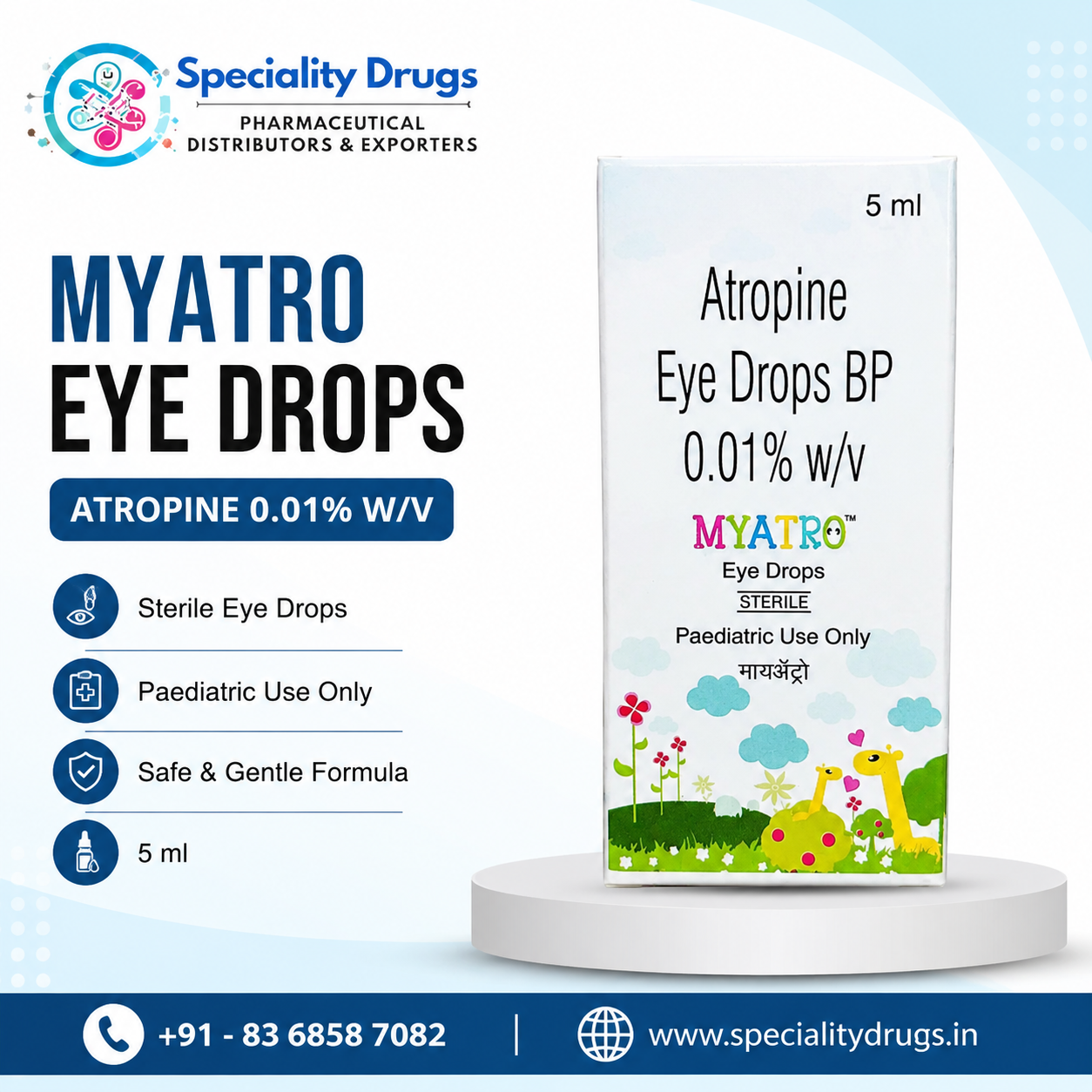
MyAtro Eye Drops contains atropine 0.01% w/v, a very low-concentration formulation of atropine intended for ophthalmic use. The supplied packaging identifies the product as sterile eye drops and states “Paediatric Use Only.” Because the exact manufacturer and approved indication are not visible on the supplied packaging, those details should be confirmed from the product carton, package insert, or dispensing pharmacy before publication.
Atropine belongs to a group of medicines known as antimuscarinic or muscarinic receptor antagonists. In the eye, atropine reduces the activity of certain muscarinic receptors and can temporarily affect the muscles responsible for focusing and pupil size. At higher concentrations, atropine produces significant pupil dilation and reduces the eye’s ability to focus on nearby objects.
Low-concentration atropine has received considerable attention in pediatric ophthalmology because of its potential role in myopia management. Myopia, commonly called short-sightedness, occurs when distant objects appear blurred because light does not focus correctly on the retina. Research has shown that low-dose atropine can slow the progression of myopia in many children, although the response can differ between individuals and studies have produced differing results depending on population, concentration, and treatment circumstances.
The 0.01% concentration has generally been investigated because it may provide myopia-control effects while causing fewer pupil and near-vision effects than stronger atropine concentrations. However, the ideal concentration, treatment duration, and age at which treatment should start or stop remain subjects of clinical evaluation.
MyAtro Eye Drops should therefore be used only when specifically recommended by a qualified ophthalmologist or other appropriate healthcare professional. It should not be started, stopped, or changed without professional advice.
MyAtro Eye Drops Uses
The exact approved uses of a particular atropine 0.01% product depend on its formulation, regulatory status, and the prescribing ophthalmologist. Low-dose atropine is commonly discussed in pediatric ophthalmology in relation to progressive myopia.
Potential clinical use under specialist supervision may include:
- Supporting the management of progressive childhood myopia.
- Helping slow changes in refractive error in selected children.
- Supporting a broader myopia-management plan that may include appropriate spectacles, contact lenses, outdoor activity, and regular eye examinations.
- Providing a low-concentration atropine option when an ophthalmologist considers pharmacological myopia control appropriate.
Research from pediatric ophthalmology organizations indicates that low-dose atropine may slow myopia progression, but doctors continue to evaluate the most appropriate concentration, treatment duration, and patient selection.
Atropine ophthalmic preparations at other concentrations can also be used for purposes such as pupil dilation during eye examinations and management of certain inflammatory eye conditions. These uses should not automatically be assumed for a specific 0.01% product.
This medicine should only be used under the supervision of a qualified healthcare professional.
MyAtro Eye Drops Benefits
When prescribed appropriately, low-concentration atropine may offer several potential benefits as part of pediatric myopia management.
- May slow myopia progression: Clinical research has found that low-dose atropine can reduce the rate at which myopia progresses in many children.
- Low concentration: The 0.01% formulation contains a much lower concentration of atropine than conventional 1% atropine preparations.
- Generally fewer visual effects: Lower concentrations tend to cause less pupil dilation and less disruption of near focusing than stronger formulations.
- May support long-term eye-health planning: Slowing childhood myopia progression can form one part of a comprehensive strategy for managing increasing myopia.
- Suitable for specialist monitoring: Children receiving myopia-control treatment can be regularly assessed through eye examinations and measurements of refractive error and, where appropriate, eye growth.
These benefits should not be interpreted as a guarantee of treatment success. Individual responses vary, and ongoing ophthalmic monitoring is important.
How Does MyAtro Eye Drops Work?
Atropine works primarily by blocking muscarinic receptors, which are involved in the action of the neurotransmitter acetylcholine. In the eye, this activity affects the iris and the ciliary muscle responsible for accommodation, or focusing on near objects.
The precise mechanism through which low-dose atropine slows childhood myopia progression is not completely understood. Research suggests that atropine’s effects on retinal and other ocular signaling pathways may contribute to its influence on eye growth. The relationship is more complicated than simply preventing the eye from focusing at near distances.
At 0.01%, the effects on pupil size and accommodation are generally much smaller than those associated with higher atropine concentrations. This is one reason low-dose formulations have been studied for children who require myopia management.
How to Use MyAtro Eye Drops
MyAtro Eye Drops should be used exactly according to the ophthalmologist’s instructions. The appropriate frequency and duration depend on the child’s condition and the treatment plan.
General eye-drop safety principles include:
- Use the medicine only when prescribed or recommended by an appropriate healthcare professional.
- Wash hands before handling the bottle.
- Do not allow the dropper tip to touch the eye, fingers, skin, or another surface.
- Keep the bottle properly closed when it is not being used.
- Do not change the prescribed frequency or concentration independently.
- Do not share the eye drops with another person.
- Attend scheduled eye examinations so the child’s response can be evaluated.
The product should not be used as a substitute for regular vision testing or professional myopia assessment.
MyAtro Eye Drops Side Effects
Like all medicines, MyAtro Eye Drops may cause side effects, although not everyone experiences them.
Common or Possible Side Effects
Depending on individual sensitivity, atropine eye drops may cause:
- Temporary eye irritation or redness
- Increased sensitivity to bright light
- Mild pupil enlargement
- Temporary blurred vision, particularly for near activities
- Eyelid irritation or swelling
- Dry mouth or other effects outside the eye, particularly if more medicine than intended is absorbed
Low concentrations generally produce fewer pupil and near-vision effects than stronger atropine preparations, but side effects can still occur.
Serious Side Effects
Seek prompt medical attention if significant or unusual symptoms occur, such as:
- Severe eye pain or marked eye inflammation
- Significant swelling or an allergic reaction
- Fast or irregular heartbeat
- Fever
- Confusion or unusual behavioral changes
- Difficulty passing urine
Systemic effects are uncommon but can occur with atropine.
If side effects persist or become severe, contact your healthcare provider promptly.
Warnings and Precautions
Before using MyAtro Eye Drops, the child’s ophthalmologist should know about any existing medical conditions and medicines being taken.
Particular caution may be appropriate in children with:
- A known allergy or previous reaction to atropine or related medicines.
- Certain types of glaucoma or conditions involving increased eye pressure.
- Significant eye disease or inflammation.
- Other medical conditions that may increase sensitivity to anticholinergic medicines.
Atropine can cause pupil enlargement and light sensitivity. Some children may therefore benefit from appropriate protection from bright light as advised by their eye-care professional.
Parents or caregivers should also tell the doctor about prescription medicines, over-the-counter products, vitamins, and herbal supplements. Some allergy medicines, cough and cold preparations, and other medicines with anticholinergic effects may interact with atropine.
Because this product is labeled for pediatric use, administration should be supervised by a parent, caregiver, or healthcare professional as appropriate.
Drug Interactions
Atropine may interact with medicines that have similar anticholinergic effects. Examples can include certain antihistamines, cough and cold medicines, and other medicines that influence the nervous system.
Before treatment, provide the ophthalmologist or pharmacist with a complete list of the child’s:
- Prescription medicines
- Over-the-counter medicines
- Vitamins and nutritional supplements
- Herbal products
- Other eye drops or ophthalmic preparations
Do not begin another medicine specifically to manage side effects without first discussing it with a healthcare professional.
Storage Instructions
Follow the storage instructions printed on the product packaging or supplied by the pharmacist. In general:
- Keep the bottle tightly closed.
- Store it according to the manufacturer’s specified temperature requirements.
- Protect the medicine from excessive heat and moisture.
- Keep it away from direct contamination.
- Keep out of reach and sight of children.
- Do not use the product after its expiry date.
- Do not use the eye drops if the packaging or solution appears damaged or otherwise unsuitable.
- Do not share the bottle with another person.
For specific storage requirements, the product label and package insert should take priority.
MyAtro Eye Drops Price and Manufacturer Information
The MyAtro Eye Drops price can vary depending on the pharmacy, location, pack size, taxes, and dispensing arrangements. Because pricing changes over time, the current price should be confirmed directly with an authorized pharmacy or healthcare provider.
The supplied photograph clearly shows the product name, atropine 0.01% w/v strength, 5 mL pack size, sterile eye-drop formulation, and pediatric-use labeling. However, the MyAtro Eye Drops manufacturer is not clearly visible in the provided image. A manufacturer should therefore not be added to a product listing unless it is confirmed from the complete packaging or official product documentation.
Frequently Asked Questions
1. What is MyAtro Eye Drops used for?
MyAtro contains low-concentration atropine 0.01% w/v. Low-dose atropine is used by some ophthalmologists as part of treatment for progressive childhood myopia. The precise indication for a particular product should be confirmed with the prescribing eye specialist because formulations and regulatory approvals can vary.
2. How does MyAtro Eye Drops work?
Atropine blocks muscarinic receptors in the eye. The exact way low-dose atropine slows myopia progression is not completely understood. Research suggests that atropine may influence biological signaling involved in eye growth. At the 0.01% concentration, its effects on pupil size and near focusing are generally less pronounced than with stronger concentrations.
3. Is MyAtro Eye Drops safe for children?
Low-dose atropine has been studied extensively in children, and many studies report that it is generally well tolerated. However, safety depends on the individual child and medical circumstances. Possible effects include light sensitivity, pupil enlargement, irritation, and blurred near vision. Use should be supervised by an ophthalmologist.
4. Can MyAtro Eye Drops be used for a long time?
The appropriate treatment duration varies from child to child. Some myopia-management programs use atropine for an extended period while monitoring refractive error and eye growth. The decision to continue, change, or stop treatment should be made by the child’s ophthalmologist rather than independently.
5. What happens if a dose is missed?
If a prescribed dose is missed, do not automatically compensate by giving extra medicine. The appropriate response depends on the treatment schedule. A parent or caregiver should follow the instructions provided by the prescribing clinician or pharmacist rather than changing the treatment plan independently.
6. Can MyAtro Eye Drops be stopped suddenly?
Treatment should not be stopped without discussing it with the ophthalmologist. Myopia may continue progressing after treatment ends, and some studies have investigated rebound progression after stopping atropine, particularly with stronger concentrations. The doctor can determine when and how treatment should be discontinued.
7. Can MyAtro Eye Drops be used with other eye treatments?
It may be possible to use atropine alongside other eye treatments, but this should be determined by the ophthalmologist. If multiple eye drops are prescribed, the healthcare professional can provide instructions about their use and timing.
8. What are the common MyAtro Eye Drops side effects?
Possible effects include temporary light sensitivity, pupil enlargement, eye irritation, eyelid swelling, and blurred near vision. Low-dose formulations generally produce fewer visual side effects than higher-strength atropine. Any persistent, severe, or unusual symptom should be reported to a healthcare professional.
9. Who should avoid MyAtro Eye Drops?
Children with known atropine allergy or certain eye conditions may require alternative treatment or additional assessment. Glaucoma and other relevant medical conditions should be discussed with the ophthalmologist before treatment. The doctor should also know about all other medicines and supplements being used.
10. How should MyAtro Eye Drops be stored?
Keep the bottle tightly closed and follow the storage conditions printed on the package or provided by the pharmacist. Protect the medicine from inappropriate heat and moisture, and keep it away from children. Do not use an expired or damaged product.
Disclaimer
This product description is provided for educational and informational purposes only and should not be considered medical advice. MyAtro Eye Drops contains atropine and is labeled for pediatric use; treatment decisions should be made by a qualified ophthalmologist or other healthcare professional.
Do not self-medicate or use atropine eye drops without appropriate medical supervision. The correct treatment plan depends on the child’s age, eye health, degree and progression of myopia, medical history, and response to treatment. Individual results may vary.
For product-specific information, including the exact manufacturer, approved indication, formulation details, storage requirements, and prescribing information, consult the official package insert or an authorized healthcare professional.
Reviews
There are no reviews yet.