
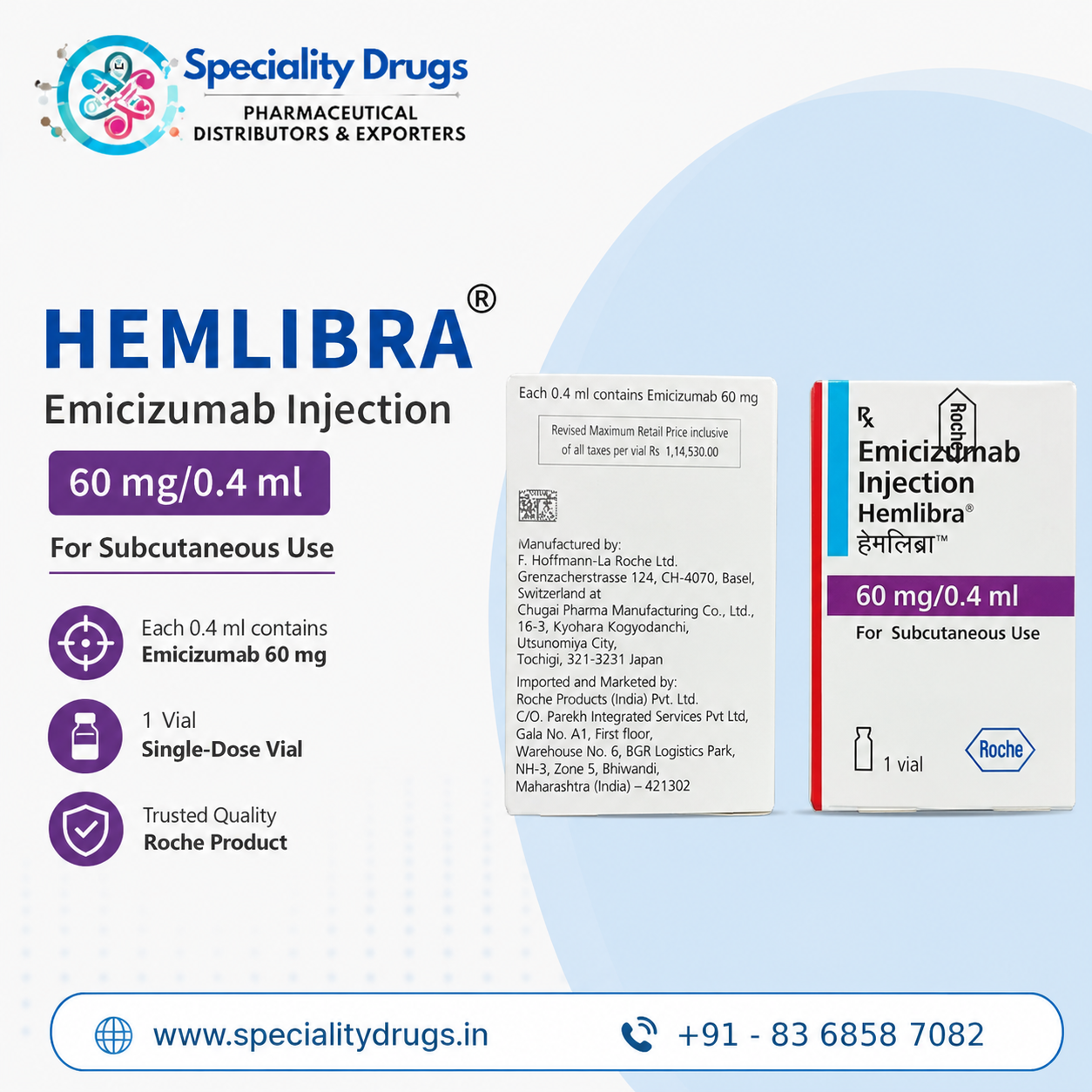
Hemlibra is a prescription medicine used as routine prophylaxis to prevent or reduce bleeding episodes in people with hemophilia A. Current prescribing information supports its use in adults and children, including newborns and older, with congenital factor VIII deficiency, whether or not factor VIII inhibitors are present.
What is Hemlibra 60 mg/0.4 mL Injection?
Hemlibra 60 mg/0.4 mL is a sterile solution containing emicizumab, a laboratory-engineered bispecific antibody. It is supplied as a single-dose vial for subcutaneous injection, meaning it is administered under the skin rather than into a vein. The 60 mg/0.4 mL strength is one of the approved Hemlibra vial strengths.
Hemophilia A occurs when the body has insufficient functional factor VIII, an important protein involved in normal blood clotting. Without adequate factor VIII activity, bleeding can be prolonged or occur more easily.
Emicizumab works differently from conventional factor VIII replacement. It is designed to bind to activated factor IX (FIXa) and factor X, bringing these clotting proteins together and helping restore the function normally provided by activated factor VIII.
Doctors prescribe Hemlibra primarily for routine prevention of bleeding, rather than as a medicine to stop every acute bleeding episode. Its prophylactic use can help reduce the frequency of treated bleeding episodes in appropriate patients with hemophilia A.
Because Hemlibra affects the blood-clotting system and can interact dangerously with certain bypassing agents, it should be used only under the supervision of a qualified hematologist or other healthcare professional experienced in treating hemophilia.
Uses of Hemlibra 60 mg/0.4 mL
Hemlibra is used for routine prophylaxis in patients with hemophilia A. Approved use includes patients with or without factor VIII inhibitors.
Hemlibra uses include:
- Routine prevention of bleeding episodes in hemophilia A.
- Reducing the frequency of bleeding episodes.
- Long-term prophylactic management of congenital factor VIII deficiency.
- Prophylaxis in patients with hemophilia A who have factor VIII inhibitors.
- Prophylaxis in patients with hemophilia A without factor VIII inhibitors.
- Supporting ongoing bleeding prevention in appropriate adult and pediatric patients.
Hemlibra is not a general blood-clotting medicine and should not be used for conditions for which it has not been prescribed.
This medicine should only be taken under the supervision of a qualified healthcare professional.
Benefits of Hemlibra 60 mg/0.4 mL
The main benefit of Hemlibra is its role in regular bleeding prevention for people living with hemophilia A.
Potential Hemlibra benefits include:
- Helps reduce the frequency of bleeding episodes.
- Provides a preventive treatment option for hemophilia A.
- Can be used in patients with or without factor VIII inhibitors.
- Provides a subcutaneous route of administration.
- Offers maintenance schedules that may be weekly, every two weeks, or every four weeks after the initial loading period, depending on the prescribed regimen.
- Supports long-term management of hemophilia A when used as prescribed.
Clinical trials have demonstrated substantial reductions in treated bleeding episodes with Hemlibra prophylaxis in appropriate patient populations, although individual responses vary.
Hemlibra does not permanently cure hemophilia A and does not eliminate the need for an individualized emergency plan for breakthrough bleeding.
How Does Hemlibra Work?
The active ingredient, emicizumab, is a bispecific antibody that targets two clotting proteins: activated factor IX and factor X.
Normally, activated factor VIII helps FIXa and FX work together during the coagulation process. In hemophilia A, factor VIII is deficient or ineffective. Hemlibra acts as a functional bridge between FIXa and FX, helping restore the clotting activity that is missing because of the factor VIII deficiency.
This mechanism allows Hemlibra to continue providing prophylactic clotting support even in patients who have developed inhibitors against factor VIII.
How to Take Hemlibra 60 mg/0.4 mL
Hemlibra is administered subcutaneously. It should be used exactly according to the treatment plan established by the healthcare professional.
The current labeled general dosing schedule is:
- Loading phase: 3 mg/kg once weekly for the first 4 weeks.
- Maintenance phase: 1.5 mg/kg once weekly, or 3 mg/kg once every two weeks, or 6 mg/kg once every four weeks.
The exact regimen is selected by the treating healthcare professional based on the patient’s circumstances and treatment needs.
Important administration points:
- Do not change the dose or schedule yourself.
- Do not give two doses on the same day to compensate for a missed dose.
- If a dose is missed, it should generally be administered as soon as possible and the usual schedule then resumed.
- Self-injection should only be performed after appropriate training from a healthcare professional.
- The injection should be administered under the skin, not into a vein.
- Do not use the vial if the solution is discolored or contains visible particles.
The Hemlibra dosage is weight-based, so the 60 mg/0.4 mL vial should not be assumed to represent a complete dose for every patient.
Hemlibra Side Effects
Like all medicines, Hemlibra may cause side effects, although not everyone experiences them.
Common Side Effects
The most frequently reported Hemlibra side effects include:
- Injection-site reactions such as redness, pain, swelling, itching, warmth or bruising.
- Headache.
- Joint pain.
- Fever.
- Diarrhea.
In pooled clinical-trial data, injection-site reactions occurred in 22% of patients, headache in 15%, and joint pain in 15%.
Serious Side Effects
Hemlibra carries an important warning concerning thrombotic microangiopathy (TMA) and thromboembolism, particularly when activated prothrombin complex concentrate (aPCC) is used at high cumulative doses in patients receiving Hemlibra prophylaxis.
Seek immediate medical attention for symptoms that could indicate a serious clotting problem, such as:
- Sudden shortness of breath.
- Chest, abdominal or back pain.
- Severe headache or confusion.
- Weakness or numbness.
- Significant swelling or pain in an arm or leg.
- Reduced urination or other signs of kidney problems.
- Unusual changes in vision.
- Other sudden or severe symptoms suggesting a blood clot.
If side effects persist or become severe, contact your healthcare provider promptly.
Warnings and Precautions
Pregnancy
There are limited human pregnancy data for emicizumab. The prescribing information states that Hemlibra should be used during pregnancy only when the potential benefit justifies the potential risk to the fetus. Women who can become pregnant should discuss appropriate contraception with their healthcare professional.
Breastfeeding
It is not known whether emicizumab is present in human milk or what effects it could have on a breastfed infant. Breastfeeding decisions should be discussed with the treating healthcare professional.
Liver and Kidney Disease
Available pharmacokinetic information indicates that mild to moderate hepatic or renal impairment did not significantly influence emicizumab pharmacokinetics in studied populations. Severe hepatic or renal impairment has not been adequately studied. Patients with significant liver or kidney disease should therefore inform their doctor before treatment.
Heart and Blood-Vessel Conditions
Because Hemlibra affects coagulation, patients with a history of clotting problems or significant cardiovascular disease should make their complete medical history known to their healthcare provider. Particular attention is required when bypassing agents are needed.
Elderly Patients
Hemlibra has been studied in adults, but clinical trials included relatively few patients aged 65 years and older. Older patients should follow individualized medical advice.
Alcohol
There is no specific alcohol interaction highlighted in the current prescribing information. However, patients with hemophilia should discuss regular or heavy alcohol consumption with their healthcare professional.
Driving and Operating Machinery
Hemlibra is not specifically identified as a medicine that routinely impairs driving. However, patients should avoid driving or operating machinery if they experience symptoms that make these activities unsafe.
Laboratory Testing
A particularly important precaution is that Hemlibra can interfere with certain clotting tests, including aPTT-based tests and some factor VIII assays. Healthcare professionals and laboratories should know that the patient is receiving Hemlibra before interpreting coagulation results.
Drug Interactions
Hemlibra can interact with medicines used to control breakthrough bleeding.
The most important interaction involves activated prothrombin complex concentrate (aPCC). High cumulative doses of aPCC in patients receiving Hemlibra have been associated with serious thrombotic microangiopathy and thromboembolic events.
Patients should therefore never decide independently which clotting product or dose to use for a breakthrough bleed.
Tell your healthcare provider about all medicines and products you use, including:
- Prescription medicines.
- Over-the-counter medicines.
- Factor VIII products.
- Bypassing agents.
- Vitamins.
- Herbal supplements.
- Other blood-clotting or blood-thinning medicines.
Your hemophilia treatment team should provide specific instructions for managing breakthrough bleeding while you are receiving Hemlibra.
Storage Instructions
According to current prescribing information, Hemlibra should generally be:
- Stored in a refrigerator at 2°C to 8°C.
- Protected from light by keeping it in the original carton.
- Not frozen.
- Not shaken.
- Kept out of reach of children.
- Used according to the product’s instructions after transfer from the vial to the syringe.
If refrigeration is temporarily unavailable, follow the product-specific storage instructions and contact a pharmacist if you are unsure whether the vial remains suitable for use.
Do not use Hemlibra after its expiry date.
Hemlibra 60 mg/0.4 mL Price
The supplied package image shows an MRP of ₹1,14,530.00 for the pack shown. This is the printed maximum retail price visible on the provided packaging and should not be assumed to be the current selling price.
The actual Hemlibra 60 mg/0.4 mL price can vary according to pharmacy, location, discounts, taxes, procurement arrangements and changes in manufacturer pricing. Always verify the current price, batch details, expiry date and authenticity before purchasing.
Because Hemlibra is a prescription biologic medicine, buy Hemlibra online only from a properly licensed and reputable pharmacy and only with a valid prescription.
Hemlibra Manufacturer
The supplied pack identifies F. Hoffmann-La Roche Ltd., Switzerland as the manufacturer, along with Chugai Pharma Manufacturing Co., Ltd. The Indian packaging also identifies Roche Products (India) Pvt. Ltd.
Manufacturer and packaging information can vary by market and pack configuration, so the physical product label should always be checked before use.
Disclaimer
This information about Hemlibra 60 mg/0.4 mL Injection is provided for educational and informational purposes only. It is not a substitute for medical advice, diagnosis or treatment from a qualified healthcare professional.
Do not self-medicate, change the Hemlibra dosage, alter the injection schedule, or use clotting-factor or bypassing products without instructions from your hemophilia treatment team. Individual response, medical history, weight, bleeding pattern and other medicines can affect treatment decisions.
Always follow the prescription and official product instructions provided by your healthcare professional.
Frequently Asked Questions About Hemlibra
1. What is Hemlibra 60 mg/0.4 mL used for?
Hemlibra is used as routine prophylaxis to prevent or reduce bleeding episodes in adults and children with hemophilia A, including patients with or without factor VIII inhibitors. It is a preventive treatment rather than a general medicine for stopping every acute bleed. The treatment plan should be determined by a healthcare professional experienced in hemophilia management.
2. How does Hemlibra work?
Hemlibra contains emicizumab, a bispecific antibody that binds activated factor IX and factor X. By bringing these clotting proteins together, it helps restore part of the clotting function normally supported by activated factor VIII. This mechanism helps provide ongoing prophylactic protection against bleeding in appropriate patients with hemophilia A.
3. Is Hemlibra safe?
Hemlibra is an approved prescription treatment with established benefits for appropriate patients with hemophilia A, but it can cause side effects and serious complications. Injection-site reactions, headache and joint pain are common. Serious clotting complications can occur, particularly with certain uses of aPCC. Treatment should therefore remain under specialist medical supervision.
4. Can Hemlibra be used long term?
Yes. Hemlibra is designed for routine prophylactic treatment and may be used as part of long-term hemophilia A management when prescribed by a specialist. The patient’s bleeding pattern, treatment response, safety and overall medical condition should be monitored. Never discontinue long-term treatment without discussing the decision with the treating healthcare professional.
5. What happens if I miss a Hemlibra dose?
The current prescribing information states that a missed Hemlibra dose should be administered as soon as possible, after which the usual dosing schedule should be resumed. Two doses should not be administered on the same day to compensate for a missed dose. Patients should follow their healthcare professional’s instructions if there is uncertainty about a missed injection.
6. Can I stop Hemlibra suddenly?
Do not stop Hemlibra on your own. It is a prophylactic treatment intended to provide ongoing protection against bleeding. Stopping or changing therapy can alter bleeding protection and may require an alternative management plan. If you want to discontinue or switch treatment, speak with your hematologist first so that an appropriate transition plan can be established.
7. Can Hemlibra be taken with food?
Hemlibra is a subcutaneous injection, not an oral medicine, so food does not determine when the injection is administered. It can be given according to the prescribed schedule without needing to coordinate the injection with meals. The injection should be prepared and administered according to the product instructions and healthcare professional’s training.
8. What are the common Hemlibra side effects?
The most common Hemlibra side effects are reactions at the injection site, headache and joint pain. Other reported reactions include fever and diarrhea. Injection-site reactions can include redness, pain, itching, swelling, bruising or warmth. Contact your healthcare provider if symptoms are persistent, severe or unusual.
9. Who should avoid or use Hemlibra with special caution?
Patients should tell their healthcare provider about allergies, pregnancy, breastfeeding, kidney or liver disease, previous clotting problems and all current medicines. Particular caution is required when a bypassing agent such as aPCC may be needed because of the risk of serious clotting complications. The treatment team should guide management of breakthrough bleeding.
10. How should Hemlibra be stored?
Hemlibra should generally be refrigerated at 2°C to 8°C, protected from light in its original carton, and should not be frozen or shaken. Specific temporary storage allowances may apply, so patients should follow the package instructions and pharmacist or healthcare professional’s advice. Keep the medicine away from children and do not use expired vials.
Important: Hemlibra is a specialized prescription medicine for hemophilia A. The information above is intended to help patients and caregivers understand the product and should not replace individualized advice from a hematologist or other qualified healthcare professional.
Reviews
There are no reviews yet.