
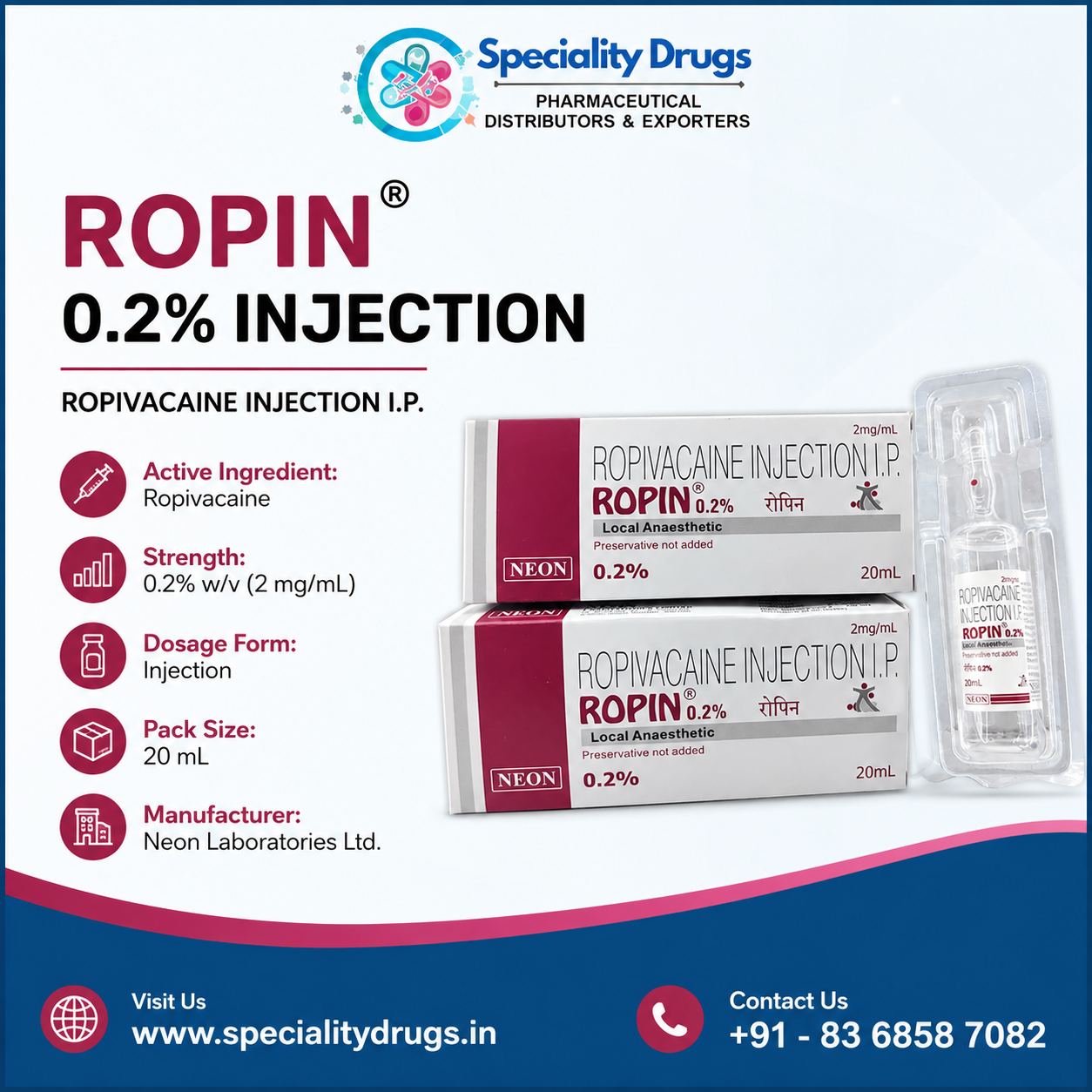
Ropin 0.2% Injection – Ropivacaine 2 mg/mL
Ropin 0.2% Injection is a prescription local anaesthetic containing ropivacaine, an amide-type local anaesthetic used by qualified healthcare professionals to produce local or regional anaesthesia and to support acute pain management in appropriate clinical settings. The product shown in the provided packaging is labelled Ropin 0.2%, with a strength of 2 mg/mL and a 20 mL presentation. The packaging identifies NEON as the manufacturer/brand associated with the product. Independent medicine references also identify Ropin 0.2% Injection as containing ropivacaine and being marketed by Neon Laboratories Ltd.
Ropivacaine belongs to the amide group of local anaesthetics. Unlike general anaesthesia, which affects the entire body, local anaesthetics are used to temporarily reduce sensation in a specific area or region. Ropivacaine works by interfering with the transmission of nerve signals, thereby reducing the ability of nerves to communicate pain and other sensations from the treated area.
Because ropivacaine injection can cause serious toxicity if improperly administered, it is intended for use by appropriately trained healthcare professionals in suitable clinical environments. Official prescribing information emphasizes precautions against unintended injection into a blood vessel and the need for appropriate monitoring and emergency support when significant regional blocks are performed.
What Is Ropin 0.2% Injection?
Ropin 0.2% Injection is a ropivacaine injection used as a local or regional anaesthetic. Its active ingredient, ropivacaine, belongs to the amide-type local anaesthetic class.
The 0.2% strength corresponds to 2 mg of ropivacaine per mL. The product is supplied as an injectable preparation and should be handled and administered only by trained medical personnel according to the clinical situation and applicable prescribing information.
Ropivacaine hydrochloride injection is medically used for local or regional anaesthesia during appropriate surgical procedures and for certain forms of acute pain management. Accepted clinical applications include epidural anaesthesia, major nerve blocks and local infiltration, depending on the formulation, clinical indication and healthcare professional’s judgement.
Ropin 0.2% Injection Uses
The main Ropin 0.2% Injection uses are related to producing temporary local or regional loss of sensation.
Healthcare professionals may use ropivacaine-containing injections for appropriate clinical purposes such as:
- Local anaesthesia for selected medical procedures
- Regional anaesthesia for appropriate surgical procedures
- Certain nerve-block techniques
- Epidural anaesthesia in suitable clinical circumstances
- Management of selected acute or postoperative pain situations
- Local infiltration when clinically appropriate
The exact indication depends on the patient’s condition, procedure, medical history and the anaesthetic technique being used. Ropivacaine should not be considered a general painkiller for self-treatment.
Ropin 0.2% Injection Benefits
The potential Ropin 0.2% Injection benefits are associated with its ability to temporarily block nerve signalling in a targeted area.
Potential clinical benefits include:
- Helps temporarily reduce sensation in a targeted region
- Supports local or regional anaesthesia during suitable procedures
- Can contribute to pain control in selected clinical situations
- Allows healthcare professionals to perform appropriate procedures while reducing sensation in the treated area
- May provide regional pain control when used as part of an appropriate anaesthetic plan
These benefits should not be interpreted as a guarantee of effectiveness for every patient. The response can vary according to the procedure, administration technique, individual health factors and other medicines being used.
How Does Ropin 0.2% Injection Work?
The active ingredient in Ropin 0.2% Injection is ropivacaine. It works primarily by blocking voltage-gated sodium channels in nerve cells.
Nerves normally transmit electrical signals that allow sensations such as pain to travel from a particular area toward the brain. Ropivacaine temporarily interferes with this process. As nerve conduction is reduced or blocked in the treated region, the patient experiences decreased sensation.
The effect is temporary, and normal nerve function generally returns as the medicine wears off. The extent and duration of anaesthesia depend on the clinical technique, concentration, amount administered and individual patient factors.
Administration and Medical Supervision
Ropin 0.2% Injection is an injectable local anaesthetic and is not intended for self-administration. It should be administered only by a suitably trained healthcare professional who understands regional anaesthesia and the potential complications associated with local anaesthetic medicines.
The appropriate administration method and amount depend on factors such as the type of procedure, anaesthetic technique, patient’s age and health status, and other medicines being used. For this reason, patients should never attempt to determine or change the amount themselves.
Official prescribing information stresses that local anaesthetics should be administered by clinicians experienced in recognizing and managing local-anaesthetic toxicity and related emergencies.
Ropin 0.2% Injection Side Effects
Like other medicines, ropivacaine may cause unwanted effects. The nature and severity of adverse reactions can depend on the administration technique, clinical circumstances and individual patient factors.
Commonly Reported Side Effects
Reported adverse reactions with ropivacaine preparations may include:
- Low blood pressure
- Nausea
- Vomiting
- Slow heart rate
- Headache
- Itching
- Abnormal sensations or tingling
- Back pain
- Fever
Not every patient experiences these effects. Some symptoms may also be related to the surgical procedure, anaesthesia technique or underlying medical condition.
Serious Side Effects
Ropivacaine can cause serious toxicity, particularly when excessive systemic exposure occurs or when the medicine is unintentionally injected into a blood vessel.
Serious reactions may involve the nervous system or cardiovascular system. Warning signs can include significant changes in consciousness, seizures, abnormal heart rhythm, severe cardiovascular effects or other symptoms requiring urgent medical attention.
Unintended intravenous administration can result in serious cardiac complications, including cardiac arrhythmias or cardiac arrest.
Warnings and Precautions
Ropin 0.2% Injection should be used only when medically appropriate and under professional supervision.
Important precautions include:
- Patients with a known hypersensitivity to ropivacaine or other amide-type local anaesthetics should not receive it.
- Healthcare professionals should consider relevant heart, liver and other medical conditions before administration.
- Particular care may be necessary in elderly or medically vulnerable patients.
- The healthcare professional should be informed about all current medicines and supplements.
- Appropriate monitoring and emergency facilities should be available when significant regional anaesthesia is performed.
- Local anaesthetics should not be injected into a joint unless the specific product and indication are approved for that purpose.
Ropivacaine prescribing information specifically warns that intra-articular infusion of local anaesthetics may cause cartilage damage and states that ropivacaine injection is not approved for this use.
Drug Interactions
Ropivacaine may interact with or have additive effects with other medicines that have similar local-anaesthetic properties.
Before receiving Ropin 0.2% Injection, the healthcare professional should know about:
- Prescription medicines
- Over-the-counter medicines
- Other local anaesthetics
- Vitamins
- Herbal products
- Dietary supplements
Concurrent use of structurally related amide-type local anaesthetics can potentially produce additive effects.
Pregnancy and Breastfeeding
Pregnancy and breastfeeding should be discussed with the treating healthcare professional before administration.
Ropivacaine may be used in certain obstetric anaesthesia settings under appropriate medical supervision, but the decision depends on the clinical circumstances and professional assessment. The healthcare team should always be informed about pregnancy, possible pregnancy or breastfeeding status before an anaesthetic procedure.
Storage Information
Storage requirements should follow the product’s approved packaging and manufacturer instructions.
General precautions include:
- Keep the medicine in its original packaging when appropriate.
- Protect it from unsuitable temperatures and excessive heat.
- Keep it away from children.
- Do not use an injection if its packaging is damaged or the product appears unsuitable.
- Check the expiry date before professional administration.
- Follow the storage conditions stated on the product label or approved prescribing information.
Ropin 0.2% Injection FAQs
1. What is Ropin 0.2% Injection used for?
Ropin 0.2% Injection contains ropivacaine, an amide-type local anaesthetic. It is used by healthcare professionals for appropriate local or regional anaesthesia and selected acute pain-management applications. The exact clinical use depends on the procedure and the patient’s circumstances.
2. What is the active ingredient in Ropin 0.2% Injection?
The active ingredient is ropivacaine. The product shown contains a concentration of 0.2%, equivalent to 2 mg/mL. Ropivacaine works by temporarily reducing nerve signal transmission in the treated area.
3. Is Ropin 0.2% Injection a painkiller?
It is better described as a local anaesthetic, rather than a conventional painkiller. It temporarily blocks nerve conduction so that sensation, particularly pain sensation, is reduced in a targeted area or region.
4. Can Ropin 0.2% Injection be self-administered?
No. Ropivacaine injection should only be administered by appropriately trained healthcare professionals. Incorrect administration can cause serious toxicity, including potentially life-threatening cardiovascular or neurological complications.
5. What are the common Ropin 0.2% Injection side effects?
Possible adverse effects associated with ropivacaine include low blood pressure, nausea, vomiting, slow heart rate, headache, itching and abnormal sensations. The actual effects depend on the patient and the anaesthetic procedure.
6. Who should not receive ropivacaine?
People with a known hypersensitivity to ropivacaine or other amide-type local anaesthetics should not receive it. The healthcare professional should also assess relevant medical conditions and medicines before administration.
7. Does Ropin 0.2% Injection cause permanent numbness?
Ropivacaine is intended to produce temporary nerve blockade. Sensation generally returns as the medicine’s effect wears off. The duration varies according to the clinical technique, administration and individual patient factors.
8. Can ropivacaine interact with other medicines?
Yes. Ropivacaine can have additive effects with other medicines that have similar local-anaesthetic properties. Patients should provide their healthcare professional with a complete list of medicines, supplements and herbal products before treatment.
9. Why is medical monitoring important with Ropin 0.2% Injection?
Monitoring is important because excessive systemic exposure or accidental injection into a blood vessel can produce serious neurological or cardiovascular toxicity. Appropriate administration by trained professionals helps reduce these risks.
10. What should patients know before receiving Ropin 0.2% Injection?
Patients should tell their healthcare professional about allergies, existing medical conditions, pregnancy or breastfeeding, and all medicines or supplements they use. Ropin 0.2% Injection should only be used when prescribed or selected as appropriate by a qualified healthcare professional.
Medical Disclaimer
This information about Ropin 0.2% Injection, ropivacaine, its uses, benefits, side effects and precautions is provided for educational purposes only. It is not a substitute for professional medical advice, diagnosis or treatment.
Ropin 0.2% Injection is a prescription local anaesthetic and should be administered only by qualified healthcare professionals in an appropriate clinical setting. Do not self-administer the medicine or change an anaesthetic treatment plan without professional guidance.
Individual responses to medicines can vary. Always follow the prescribing information and advice provided by the treating healthcare professional.
Reviews
There are no reviews yet.