
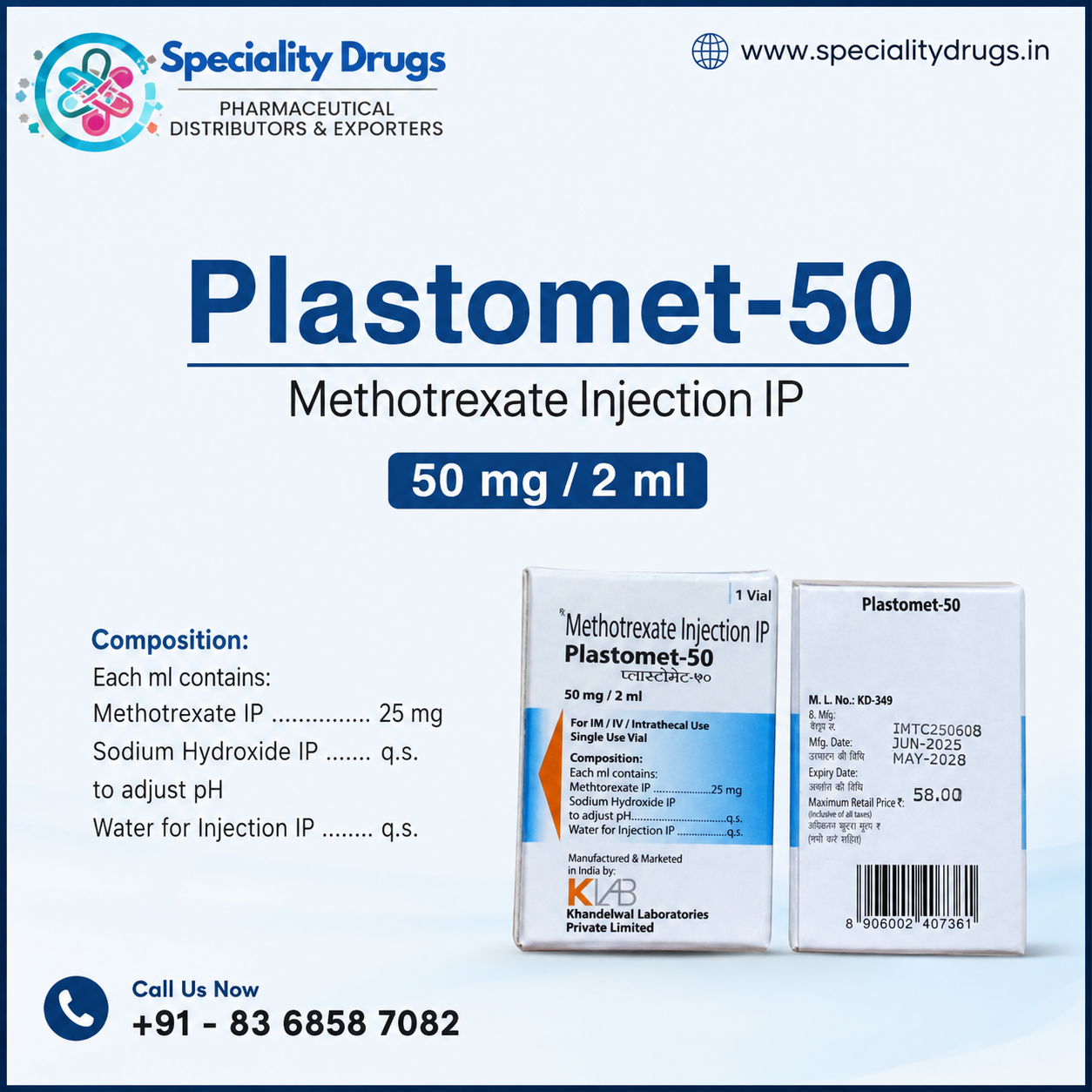
Plasomet-50 Injection (Methotrexate 50 mg/2 mL): Uses, Side Effects & Safety Information
Plasomet-50 is a methotrexate injection containing methotrexate 50 mg/2 mL. The package shown identifies it as a methotrexate injection from Khandelwal Laboratories Private Limited and indicates that it is intended for administration by a healthcare professional through specified routes. Methotrexate is a prescription medicine with important safety considerations and should never be self-administered.
This information is provided for general education. The appropriate formulation, route, treatment schedule, monitoring, and dose depend on the medical condition and the individual patient.
What is Plasomet-50?
Plasomet-50 contains methotrexate, a medicine belonging to the class of folate-antimetabolite medicines. Methotrexate interferes with folate-dependent biochemical pathways that cells need to make DNA and reproduce. Because rapidly dividing cells can be particularly sensitive to this effect, methotrexate can be used in certain cancers and, at appropriately selected lower doses, in some inflammatory or autoimmune conditions.
The exact medical use depends on the patient’s diagnosis and the treatment plan established by a qualified healthcare professional. Approved uses of methotrexate injection can include certain cancers, meningeal leukemia, rheumatoid arthritis, polyarticular juvenile idiopathic arthritis, and severe psoriasis, depending on the specific product, formulation, route, and applicable prescribing information.
The photograph supplied for this description shows Plasomet-50, Methotrexate Injection IP, 50 mg/2 mL. Because different methotrexate formulations can contain different preservatives and have different permitted routes of administration, the exact product labeling must be checked before administration.
Plasomet-50 Uses
Methotrexate injections may be used under specialist medical supervision for conditions such as:
- Certain forms of acute lymphoblastic leukemia (ALL) as part of combination chemotherapy.
- Prevention or treatment of meningeal leukemia in appropriate patients.
- Certain cases of non-Hodgkin lymphoma.
- Osteosarcoma as part of an appropriate chemotherapy regimen.
- Certain breast cancers and other specified malignancies.
- Certain head and neck cancers.
- Gestational trophoblastic neoplasia in appropriate treatment settings.
- Rheumatoid arthritis in selected patients.
- Polyarticular juvenile idiopathic arthritis in appropriate pediatric patients.
- Severe psoriasis in selected patients.
Not every methotrexate injection is appropriate for every condition. Treatment decisions depend on the diagnosis, formulation, route, laboratory results, other medicines, and the patient’s overall health.
Potential Benefits of Methotrexate Treatment
The potential benefit of methotrexate depends entirely on the condition being treated.
For cancer treatment, methotrexate can help interfere with the growth and multiplication of susceptible abnormal cells. For certain inflammatory diseases, its effects on folate-dependent cellular processes and immune activity can help control disease activity.
Potential treatment benefits may therefore include:
- Helping control certain cancers as part of a specialist treatment regimen.
- Helping manage selected inflammatory or autoimmune diseases.
- Reducing disease activity in appropriately selected patients.
- Supporting long-term disease management when prescribed for an approved indication.
Methotrexate does not provide a guaranteed cure, and the expected response varies between patients.
How Does Methotrexate Work?
Methotrexate is a folate analog metabolic inhibitor. In simple terms, it interferes with pathways involving folate, a vitamin-derived substance needed for important cellular processes, including the production of DNA.
This effect is particularly relevant to cells that are dividing rapidly. In cancer treatment, this can help limit the multiplication of malignant cells. At lower doses used for selected inflammatory diseases, methotrexate also affects immune and inflammatory pathways, helping reduce abnormal immune activity.
Because methotrexate can affect healthy cells as well as diseased cells, medical monitoring is important.
Administration and Methotrexate Dosage
Methotrexate injection should only be administered by appropriately trained healthcare professionals. The dosage and treatment schedule are highly dependent on the disease, treatment protocol, body measurements, kidney and liver function, laboratory results, and other medicines.
There is no single appropriate Plasomet-50 dosage for every patient. Some methotrexate treatment protocols are highly specialized, and accidental administration by the wrong route or at the wrong dose can cause serious or life-threatening toxicity.
Patients should therefore never change the dose, frequency, or route themselves. The healthcare team may perform blood tests and other assessments during treatment to monitor blood counts, liver function, kidney function, and other potential toxicities.
Plasomet-50 Side Effects
Like all medicines, methotrexate may cause side effects, although not everyone experiences them.
Common or Relatively Frequent Side Effects
Depending on the indication and treatment regimen, possible adverse effects may include:
- Nausea or vomiting
- Loss of appetite
- Diarrhea or abdominal discomfort
- Mouth sores
- Tiredness
- Headache
- Changes in blood-cell counts
- Increased susceptibility to infections
- Changes in liver blood tests
- Skin reactions
The likelihood and severity of adverse effects can vary substantially depending on the dose and treatment setting.
Serious Side Effects
Methotrexate can cause serious toxicity affecting several organs. Medical attention is particularly important if a patient develops:
- Signs of a serious infection
- Unusual bleeding or bruising
- Severe weakness or marked pallor
- Significant breathing difficulties or persistent cough
- Severe skin reactions
- Severe gastrointestinal symptoms
- Symptoms suggesting liver or kidney problems
- A severe allergic reaction
- New neurological symptoms
Official prescribing information warns about potentially serious toxicity involving the bone marrow, kidneys, liver, nervous system, gastrointestinal tract, lungs, and skin.
If concerning symptoms develop during methotrexate treatment, prompt medical evaluation is important.
Warnings and Precautions
Methotrexate requires careful medical supervision.
Pregnancy
Methotrexate can cause serious embryo-fetal toxicity, including fetal death. For non-cancer indications, pregnancy is a contraindication. People who could become pregnant should discuss pregnancy prevention and treatment plans with their healthcare professional.
Breastfeeding
Methotrexate treatment may not be compatible with breastfeeding. The prescribing information advises against breastfeeding during treatment; patients should discuss this with their healthcare professional.
Liver and Kidney Problems
Liver and kidney function are important when methotrexate is being considered. Patients with existing liver or kidney problems should make sure their doctor knows about them because these conditions can affect treatment safety.
Blood Disorders and Infection
Methotrexate can suppress bone marrow activity and may increase susceptibility to infections. Regular medical monitoring can help identify complications.
Intrathecal Administration
The formulation matters particularly for intrathecal use. Preservative-containing methotrexate formulations with benzyl alcohol must not be used intrathecally; preservative-free formulations are required for intrathecal administration.
Drug Interactions
Methotrexate can interact with other medicines. Patients should tell their healthcare professional about every prescription medicine, over-the-counter medicine, vitamin, and herbal supplement they use.
Important interactions can involve medicines such as:
- Certain NSAIDs and salicylates
- Some antibiotics
- Medicines affecting kidney function
- Other medicines that can suppress bone marrow
- Certain hepatotoxic medicines
- Some proton-pump inhibitors, particularly in high-dose methotrexate treatment
- Folic acid or folinic acid products, depending on the indication and treatment protocol
The clinical significance of an interaction depends on the methotrexate regimen and the patient’s condition.
Storage Information
Storage requirements should be taken directly from the specific manufacturer’s product labeling and the healthcare facility’s handling procedures.
As a general safety principle:
- Keep the medicine in its original packaging.
- Protect it from inappropriate environmental exposure.
- Do not use a vial after its expiry date.
- Keep medicines away from children.
- Healthcare facilities should follow appropriate procedures for handling cytotoxic medicines.
The vial should also be inspected according to professional handling requirements before administration.
Plasomet-50 Price and Manufacturer Information
The supplied package identifies the product as Plasomet-50 Methotrexate Injection 50 mg/2 mL and identifies Khandelwal Laboratories Private Limited as the manufacturer/marketer shown on the packaging.
The price printed on a particular package should not be treated as a current selling price because pharmaceutical prices, taxes, availability, and packaging can change. Patients should obtain current product and treatment information through an appropriate healthcare professional or authorized pharmacy.
Frequently Asked Questions
1. What is Plasomet-50 used for?
Plasomet-50 contains methotrexate, which may be used in specialist treatment of certain cancers and selected inflammatory conditions. The precise indication depends on the patient’s diagnosis and the prescribing information for the particular formulation.
2. How does Plasomet-50 work?
Methotrexate interferes with folate-dependent cellular processes needed for DNA production and cell multiplication. This helps explain its activity against rapidly dividing cells and its effects on certain immune and inflammatory processes.
3. Is Plasomet-50 safe?
Methotrexate can be an appropriate treatment when correctly prescribed and monitored, but it can also cause serious toxicity. Safety depends on the indication, formulation, route, dose, laboratory results, and other medicines being used.
4. Can methotrexate be used long term?
Some patients receiving methotrexate for inflammatory conditions may remain on treatment for an extended period, while cancer protocols may involve defined treatment cycles. Long-term use requires ongoing medical assessment and monitoring.
5. What happens if a methotrexate treatment is missed?
Patients should not independently compensate for a missed treatment. The appropriate action depends on the treatment protocol. Contact the treating healthcare team for specific instructions.
6. Can methotrexate be stopped suddenly?
Methotrexate treatment should not be changed or discontinued without medical advice. The consequences of stopping treatment depend on the condition being treated and the treatment plan.
7. Can methotrexate be taken with food?
This question depends on the particular methotrexate formulation and route. Plasomet-50 is an injectable product and is not a medicine that patients should administer themselves based on food-related instructions.
8. What are the common Plasomet-50 side effects?
Possible adverse effects include nausea, gastrointestinal symptoms, mouth sores, tiredness, changes in blood counts, infection risk, liver-test abnormalities, and skin reactions. Serious reactions can also occur.
9. Who should avoid methotrexate?
Methotrexate may be unsuitable for people with certain conditions, including pregnancy for non-neoplastic indications, severe hypersensitivity to methotrexate, and particular blood, liver, kidney, or immune problems. A healthcare professional must determine suitability.
10. How should Plasomet-50 be stored?
Storage should follow the specific manufacturer’s labeling and professional handling requirements. The product should remain appropriately stored, protected from unsuitable environmental conditions, and kept away from children.
Disclaimer
This article is intended for general educational purposes only and does not constitute medical advice, diagnosis, or treatment. Plasomet-50 contains methotrexate, a potent prescription medicine that can cause serious adverse effects if used incorrectly. Do not self-medicate or attempt to administer methotrexate injection without qualified medical supervision. Always follow the prescription, product labeling, and instructions provided by the treating healthcare professional. Individual treatment requirements and responses can vary.




Reviews
There are no reviews yet.